ChatGPTs Bild zum Text, inspiriert vom Stil von Wassily Kandinsky.
Querschnittstechnologien wie KI brauchen normalerweise Generationen, bis die meisten Menschen oder Unternehmen sie tatsächlich nutzen:
The economic literature on general-purpose technologies documents a recurring pattern: widespread adoption and productivity effects arrive slowly, often decades after invention.
Steam power and electrification took 40 years or more to diffuse broadly across the economy; computers and information technology took roughly 25 years from early commercial availability in the 1970s to pervasive business adoption in the mid-1990s.
Warum dauert das normalerweise so lange?
To understand why these lags occur and whether the trajectory of AI technology might be different, it is useful to decompose adoption costs into two categories.
The first is the cost of access and usage—what firms must pay before and while using the technology.
Electrification required connection to a power grid that took decades to build, and electricity itself remained expensive for decades.
The internet required networking infrastructure, hardware, and technical expertise.
Even after firms made the necessary investments to gain access to these new technologies, high usage costs limited the range of applications that were economically viable.
Technologies diffuse widely only after both barriers fall: the technology must be accessible, and usage must be affordable.
The second category is organizational adjustment costs—the softer, often slower process by which firms and workers learn to use a new technology effectively.
Even after electricity was widely available and affordable, factories took a generation to reorganize their floor layouts around distributed electric motors, rather than central steam shafts.
The productivity gains from information technology similarly lagged adoption by a decade or more, as firms redesigned workflows, retrained workers, and developed new managerial practices.
These organizational co-invention costs are more difficult to observe and often slower to resolve, as they depend on firm-level capabilities, managerial practices, and industry-specific constraints that vary across sectors and use cases.
KI ist anders:
Artificial intelligence, delivered through APIs, faces a fundamentally different cost structure.
The physical infrastructure required for access—the internet, cloud computing platforms, electricity grids, and connected devices—already exists.
A firm that wants to adopt LLMs does not need to build roads or string wires; it needs an API key and a few lines of code.
This means that access to AI can diffuse far faster than access to electricity or the internet.
The cost of usage has also collapsed at an unprecedented rate.
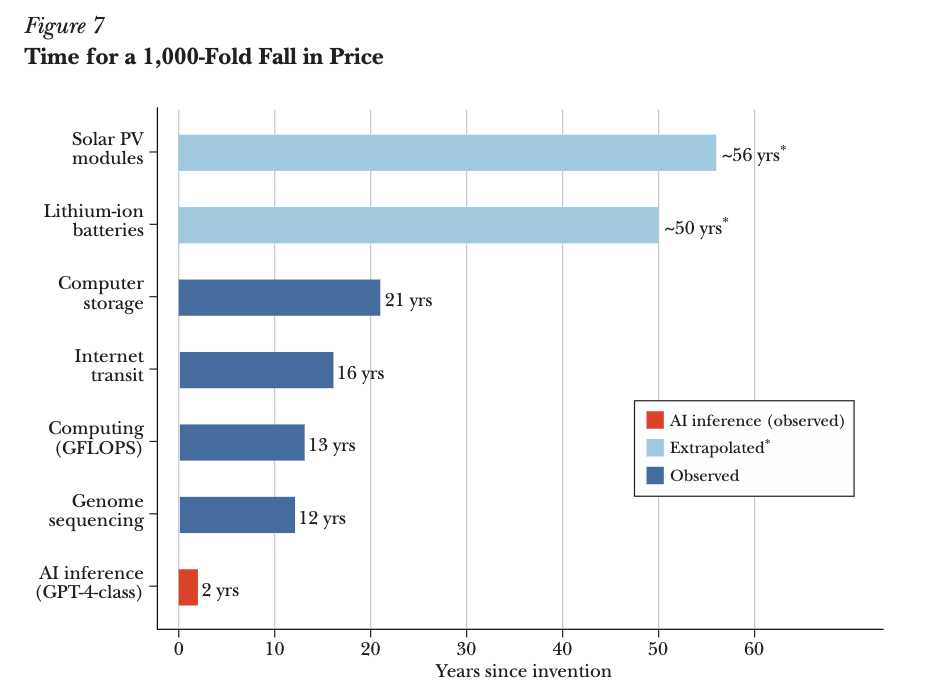
Figure 7 compares how quickly the prices of several foundational technologies declined, measured as the number of years required for a 1,000-fold fall in price.
AI inference stands out as an extreme case: the price of GPT-4-class inference fell roughly 1,000-fold in about two years, far faster than internet transit, genome sequencing, computing, or computer storage, and vastly faster than the trajectories implied by batteries and solar.
The broader pattern is that newer digital technologies can experience extraordinarily rapid cost compression.
For AI, this means that both components of the cost barrier—the cost of access and the cost of usage—have fallen faster than for any comparable technology.
Warum sehen wir noch keine Explosion in der Produktivität von Firmen? Zwar hat sich KI so schnell verbreitet wie nie zuvor eine Technologie dieser Art.
Was aber bleibt sind organisatorische Anpassungskosten. Hier mahlen die Mühlen notwendigerweise langsam:
In other settings—healthcare, law, finance, manufacturing—the organizational bottleneck is considerably more binding.
A hospital system considering the possibility of adopting AI diagnostic tools, for example, must also redesign clinical workflows, obtain regulatory clearance, retrain staff, and address liability structures.
A law firm would have to develop quality-control procedures and navigate evolving professional-responsibility guidance.
Querschnittstechnologien wie Elektrizität, IT oder KI brauchen komplementäre Produkte, damit man sie effektiv nutzen kann. Bei der Elektrizität waren das etwa standardisierte Elektromotoren, in der IT Enterprise Software.
Das fehlt bei KI noch großteils, dürfte sich aber bald ändern:
While the market described in this paper has developed the models and inference technologies and made them widely accessible, the complementary applications that translate these capabilities into usable products remain in their infancy, except for a few industries.
Currently, a large ecosystem of startups—backed by billions of dollars in venture capital—is rapidly developing complementary applications.
How quickly these markets produce compelling products—and how rapidly firms adapt their internal processes to integrate them—will be central to determining AI’s ultimate economic impact.