
Immer weniger Babies


Die Anzahl der Geburten auf der Welt wird vielleicht nie wieder so hoch sein, wie sie auf dem bisherigen Höhepunkt, 2012, war.
Bis 2300 könnten nur mehr 16 Millionen Babies pro Jahr auf die Welt kommen, statt 146 Millionen, wie vor einigen Jahren:
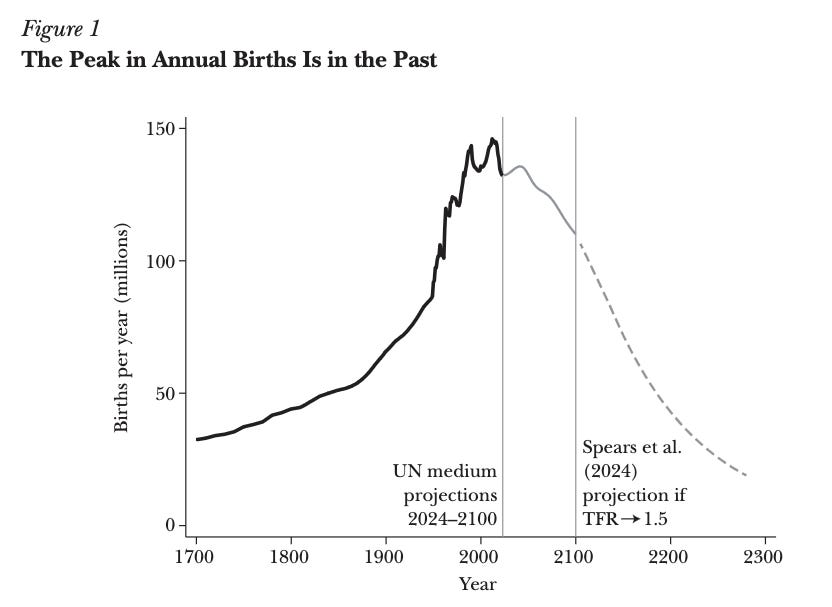
Die Grafik ist aus einer neuen Studie, die im Journal of Economic Perspectives erschienen ist. Das ist natürlich eine grobe Projektion. Aber die Geburtenrate ist seit 1970 von im globalen Durchschnitt fünf Kindern pro Frau kontinuierlich gesunken:
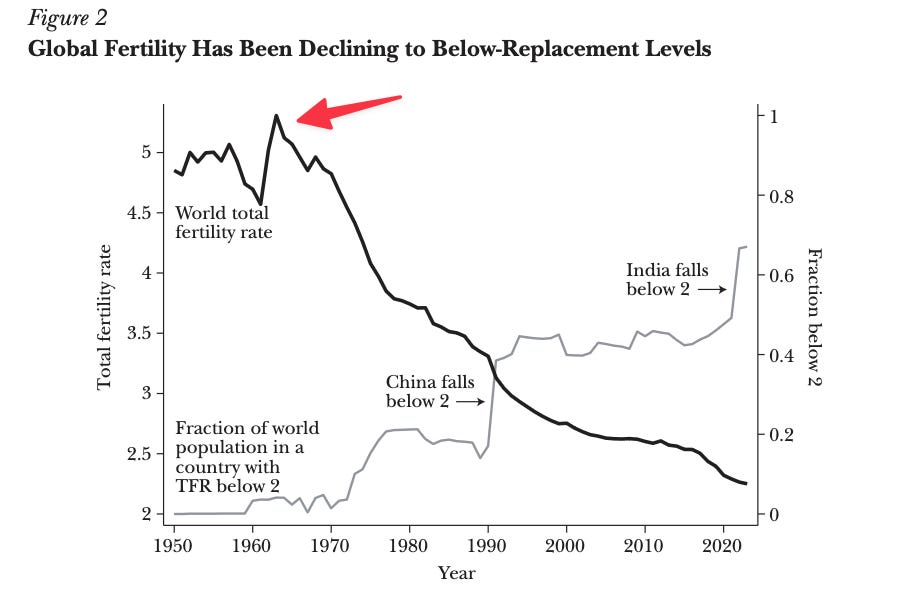
Und sie dürfte auch weiter sinken, wie die Autoren schreiben:
These projections raise the questions that are the focus of this article: Is this sort of future, in fact, likely? Could low birth rates persist? The facts and evidence that we present here indicate that sustained global depopulation is a likely possibility.
Aus der Zusammenfassung der Studie:
There is no reason found in evidence to expect a certain, automatic reversal—not from the evidence in the discipline-spanning literature on long-run fertility trends and policy impacts, and not in the evidence presented in this article.
To put it bluntly, history offers no examples of societies recognizing very low birth rates as a social priority and then responding with effective changes that restore, and sustain, replacement-level fertility.
If changes that would bring global birth rates back to replacement after they fall below it are unlikely, then a long period of global depopulation would be a likely future.
Our times, in which a large number of people exist on the planet, would be a historical anomaly that will come to an end.
Bisher hat die Politik darauf noch kein Gegenrezept gefunden. Könnte es eines geben?
What about much more transformative changes, larger than anything yet seen, that would make parenting more supported and valued, fairer, and more readily compatible with other aspirations for life—education, career, other relationships, and life projects?
Could that avoid global depopulation?
The econometric evidence cannot address this question because only small efforts have been tried, and this question is not about small efforts.
Elsewhere, we have written: “Some policies have tweaked the edges of our societies and economies. But nobody has tried anything that would adequately challenge conventions, challenge social orders, and challenge what gets society’s attention, power, and investment. No revolution has yet envisioned a future in which everyone who benefits from a healthy, joyful childhood looks forward to sharing in the work of giving one to the next generation” (Spears and Geruso 2025).
We hope such a change someday occurs.
But choosing that sort of investment would involve a massive reorganization of social priorities—beyond an extension of parental leave, beyond a modest child tax credit, beyond subsidized childcare, and so on.
There is no reason to assume that societies will choose to do so much, even if birth rates continue to hit new lows.